Vacuum lifters: technology, use & selection at a glance
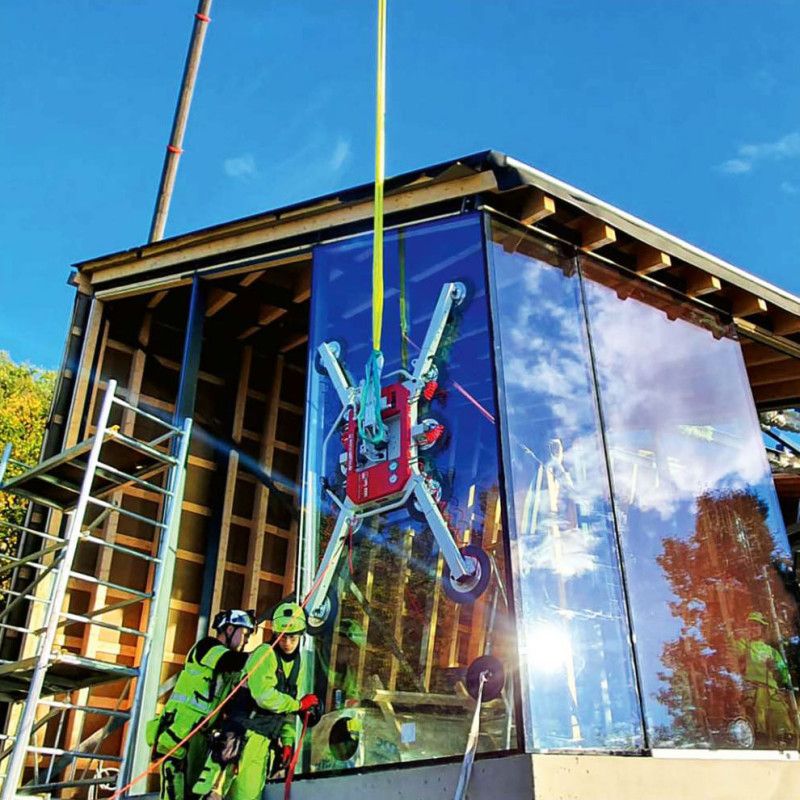
Anyone who has to move heavy glass panes, stone slabs or metal panels without damage quickly reaches their limits with chains, slings and hooks. Vacuum lifters solve this problem — they grip the load over its whole surface, without damaging edges, and transfer the force evenly onto the entire surface. What lies behind this, which designs there are and what you have to pay attention to in the selection is explained by this guide.
What is a vacuum lifter?
A vacuum lifter is a lifting device that grips loads by negative pressure. At the contact surface between the suction pad and the workpiece, air is extracted. The resulting pressure difference generates the holding force. The larger the suction area and the higher the vacuum, the heavier the manageable load.
The basic principle is simple — the technical implementation is not. Industrial vacuum lifters for loads from 200 kg work with several suction circuits, integrated vacuum pumps, pressure monitors and safety valves. A pressure drop in the system automatically triggers an alarm and prevents an uncontrolled setting-down of the load.
Distinction from the glass lifter: the term „glass lifter“ describes the same type of device, but refers to the classic use in glass construction. Vacuum lifter is the technically correct umbrella term and includes all deployment materials — glass, stone, metal, concrete.
Designs and types
Hand-guided vacuum lifters
For loads up to approx. 400 kg. Two to four operators guide the device manually. Use above all for the near-ground laying of natural stone, large-format bricks or small-format glass panes. No crane coupling required.
Crane-coupled vacuum lifters (glass-suction systems)
The main category for façade and structural construction. The device is hooked onto the load hook of a mini crane, Roto telehandler or mobile crane. Typical load capacities lie between 500 kg and 3,000 kg. Modern systems enable stepless rotation and tilting of the load — important for the millimetre-precise positioning of façade elements.
Special features of crane-coupled systems:
-
Multi-circuit vacuum system: if one suction circuit fails, the remaining ones hold the load
-
Integrated battery storage: maintains the vacuum even when the pump is at a standstill
-
Radio remote control: the operator can guide the load from the optimal position, without direct contact
-
Tilt and rotation function: the pane is aligned directly at the installation location
Vacuum lifters for telehandlers
Roto telehandlers (e.g. the Manitou MRT series) can be combined with vacuum lifters via the quick-change system. The telehandler takes over lifting and reach, the vacuum lifter the safe grip. On construction sites without a crane set-up area, this combination is the most economical solution.
Technical data at a glance
The relevant parameters in the selection:
-
Nominal load capacity: maximum load in kg — always choose with a safety factor ≥ 2:1 relative to the actual load
-
Suction area: determines the achievable holding force; larger panes require more suction heads
-
Vacuum depth: specified in mbar; the deeper the vacuum, the higher the holding force per cm²
-
Number of suction circuits: at least two for safety-relevant applications (BGV D8, DGUV Grundsatz 308-007)
-
Rotation range: 0–360° on modern systems
-
Tilt angle: ±90° enables horizontal and vertical lifting
-
Power supply: 230 V mains, 24 V battery or pneumatic
-
Dead weight: relevant for the residual payload of the crane
Areas of use and typical projects
Glass construction and façade installation
The classic field of application. Triple glazing for office buildings weighs 380–600 kg depending on the format; special panes for lobbies and showrooms regularly exceed 800 kg. With muscle power, lifting slings or simple crane hooks, these loads cannot be positioned without damage. A crane-coupled vacuum lifter grips the pane flat; the operator turns it by radio into the installation position.
Natural stone and large-format tiles
Stone slabs from 600 × 600 mm with a 30 mm thickness can weigh over 50 kg per piece in the case of granite. Conventional laying is physically demanding and prone to errors. Vacuum lifters enable precise placement without pinch marks and scratches on the polished surface.
Machine relocation and industrial installation
Smooth machine parts, steel plates or stainless-steel covers can be moved by vacuum lifter faster and with less personnel than with conventional lifting equipment. Prerequisite: the surface is dense enough for an adequate vacuum build-up.
Solar-panel installation
Solar modules are sensitive, light and offer no mechanical gripper attack points. Vacuum lifters are the standard tool for the installation of large photovoltaic systems.
Selection criteria
Step 1 – determine load and geometry
Define the weight and dimension of the heaviest planned load. Weight × 2 = minimum nominal load capacity of the vacuum lifter.
Step 2 – check the surface condition
Vacuum lifters only function on airtight, smooth surfaces. Raw-fired concrete, coarsely profiled glass or porous natural stone can prevent the required vacuum depth. Manufacturer data sheets state the suitable materials.
Step 3 – match the lifting equipment
The vacuum lifter is always an attachment. The carrying system — mini crane, Roto telehandler or mobile crane — must be able to carry the sum of load and lifter dead weight. With the Roto telehandler, the reduced load chart with an attachment is to be taken into account.
Step 4 – clarify safety requirements
For loads over persons or in public areas, the requirements of DGUV Grundsatz 308-007 apply. At least two independent vacuum circuits and a holding-time test before every use are mandatory.
Step 5 – decide on rental or purchase
Anyone who needs vacuum lifters only on a project basis is more economical with renting. Acquisition costs for crane-coupled systems lie, depending on the equipment, between 15,000 and 60,000 euros. For a self-managed construction site, renting pays off from the first day.
Safety and regulations
The relevant basis for vacuum lifters in commercial use is the DGUV Grundsatz 308-007 (vacuum lifters — load-lifting devices with negative pressure). Key requirements:
-
Before every use: holding-time test with the planned load; the vacuum may only drop minimally within a defined time
-
At least two independent suction circuits for loads over persons
-
Regular inspection by a competent person (at least annually, DGUV Vorschrift 3)
-
Operating instructions and instruction of the operators before the start of use
-
PPE for all persons in the load area
Luibl Rental delivers rented systems with current inspection certificates and, on request, advises on the necessary safety measures on site.
Rent vs. buy – when what?
Renting makes sense when:
-
Vacuum lifters are needed only for one or a few projects
-
Different loads and glass formats require different suction heads
-
No own crane is available — Luibl rents out a mini crane and vacuum lifter as a combined solution
-
Investment capital is to be conserved
Purchase is worthwhile with:
-
Permanent utilisation with loads of the same type
-
An own crane fleet and a fixed deployment profile
-
Special requirements that no standard rental device fulfils
FAQ
Which surfaces are suitable for vacuum lifters?
Smooth, non-porous and airtight surfaces: float glass, polished natural stone, painted metal, stainless steel, ceramics. Not suitable: rough concrete, textured glass, open-pored sandstone.
Can I use a vacuum lifter without a crane?
Yes — for loads up to approx. 400 kg there are hand-guided systems that two to four people operate without lifting equipment. For heavier loads, a crane or telehandler is required as a carrying device.
How long does the vacuum hold if the pump fails?
Modern systems have an integrated battery storage. The holding time without an active pump is 30–60 minutes depending on the system — sufficient to set the load down in a controlled manner.
What does it cost to rent a vacuum lifter?
The rental costs depend on the load capacity, equipment and rental duration. At Luibl you receive, on request, a combined offer of a vacuum lifter and a matching crane or Roto telehandler.
Do I need a special permit for use?
No — but a risk assessment and operating instructions in accordance with the BetrSichV are mandatory for commercial use. Luibl is happy to advise on this.
Uplifter UPG vacuum lifters – technology from the Luibl Group
The vacuum-lifter expertise within the Luibl Group comes from Uplifter — a specialist with over 20 years of experience in glass lifting technology, which has belonged to the Luibl Group since the beginning of 2026. Uplifter develops and produces the UPG series itself and rents it out throughout Germany, on request also with an operator.
The UPG models are silicone-free glass lifters with a two-circuit vacuum system, mains-independent battery power supply (up to 8 hours of operation) and an acoustic vacuum-loss warning. All models are designed for crane use and can be combined directly with Maeda mini cranes.
Uplifter UPG model overview:
-
UPG 300 — up to 300 kg load capacity, approx. 40 kg dead weight; outer suction pads adjustable in angle for curved panes; removable suction pads usable as individual hand lifters
-
UPG 350 — up to 350 kg load capacity, approx. 43 kg dead weight; manual tilting 90°, rotation 360° (45° increments); 12 V battery with LED charge indicator
-
UPG 450 — up to 450 kg (6 suction pads), approx. 57 kg dead weight; slim design; operation up to 8 hours; ergonomic hand slide valve
-
UPG 600 — up to 600 kg (8 suction pads), approx. 89 kg dead weight; radio remote control optional; permanent vacuum monitoring with re-pumping on pressure drop
-
UPG 1000 — up to 1,000 kg (10 suction pads), approx. 126 kg dead weight; modular construction with extension arms for large-area elements; two-circuit system
-
UPG 1200 — up to 1,200 kg load capacity, approx. 150 kg (without tilt unit); installation depth only 265 mm; radio remote control as standard; crane eyes for use behind scaffolding; quick-change system for combination with the GW1125 glass lifting hoist
All UPG models have silicone-free suction pads (300 mm diameter) that leave no marks on the glass surface — important for visible façade elements and polished materials.
Renting vacuum lifters at Luibl and Uplifter
Luibl Rental rents out vacuum lifters as an attachment for mini cranes (Maeda crawler cranes) and Roto telehandlers (Manitou MRT series). The combination of a compact crane and a UPG vacuum lifter is particularly suitable for cramped interiors, façade projects and glass installations in the inner city — where a large mobile crane finds no set-up area.
For pure vacuum-lifter requirements without a crane, Uplifter is available as a sister brand: rental and purchase, at short notice, throughout Germany, on request with a trained operator.
All rented systems are delivered with current inspection certificates.
→ Rent a mini crane — Maeda crawler cranes, combinable with Uplifter UPG glass lifters
→ Rent a Roto telehandler — Manitou MRT with a vacuum-lifter attachment
→ Rent an Uplifter vacuum lifter — UPG models 300 to 1200 kg, with and without an operator
→ Contact and quote request